
Desserts
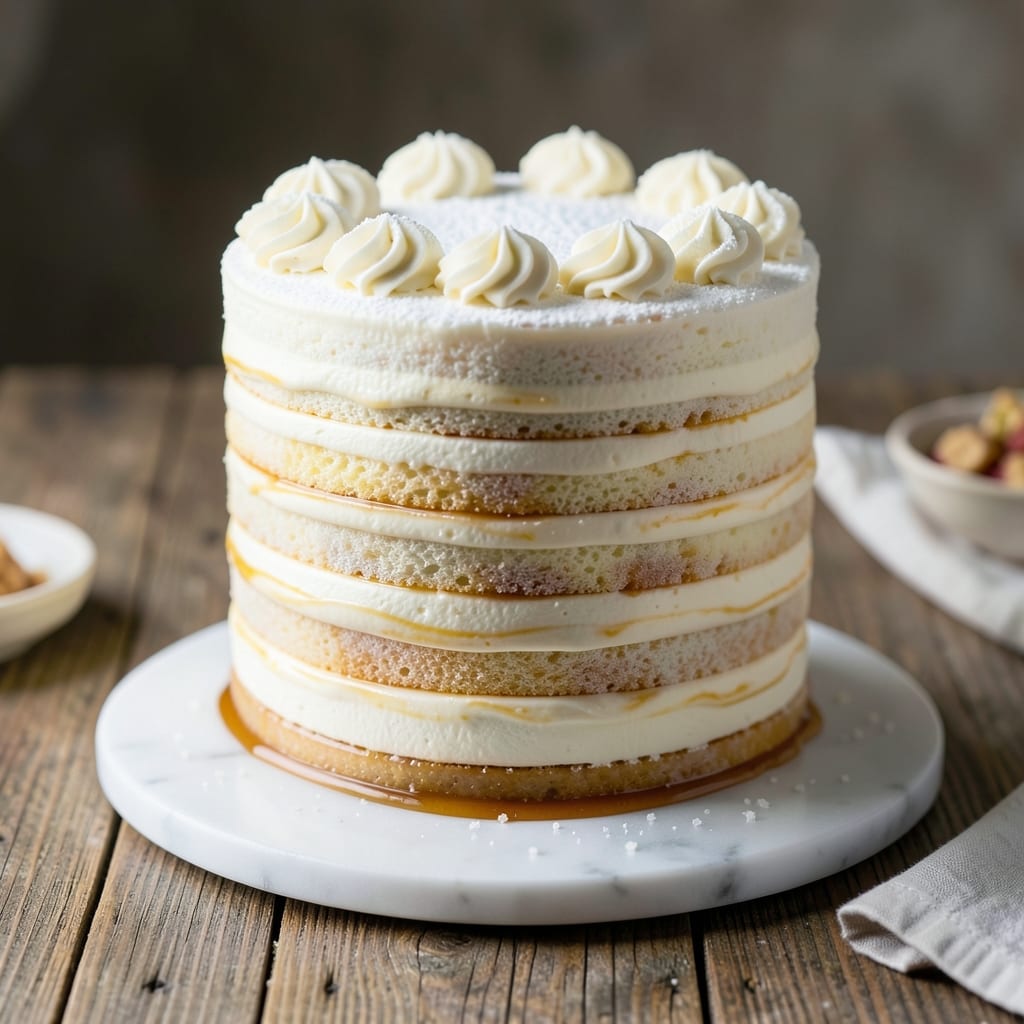
Mastering a 100-layer cake transforms simple ingredients into a showstopping dessert that looks like it belongs in a pastry chef's showcase. The secret lies in perfectly baked layers, vanilla bean frosting swirls, and a crunchy almond topping that adds texture and elegance. This recipe delivers restaurant-quality results with precise techniques and patience—no shortcuts, just layers of perfection.
The foundation starts with thin, delicate cake layers baked at 350°F for just 5-7 minutes each, ensuring they stay tender yet sturdy enough to hold the filling. Between each layer, a vanilla bean frosting—infused with real vanilla extract and whipped to a light consistency—creates those signature swirls. The almond topping, made from toasted almonds and butter, adds a satisfying crunch that contrasts beautifully with the soft layers.
What makes this cake truly special is the assembly process, where precision meets artistry. Each layer is stacked with care, and the frosting is spread evenly before swirling in a continuous motion to mimic the classic 100-layer effect. The almond topping is pressed gently on top, ensuring it stays intact while adding a sophisticated finish. Every bite delivers a harmonious blend of tender cake, creamy frosting, and nutty crunch.
Perfect for celebrations, this cake requires patience and attention to detail, but the result is worth every layer. Whether you're baking for a special occasion or simply indulging in a dessert masterpiece, this recipe will elevate your baking skills and impress anyone who takes a slice. Let’s get started on creating your own edible masterpiece.
Ingredients for 100 layer cake
Twelve ingredients transform into a masterpiece of delicate layers, creamy swirls, and nutty crunch.
| Ingredient | Amount | Notes |
|---|---|---|
| All-Purpose Flour 🌾 | 6 cups | Sifted for light texture |
| Granulated Sugar 🍚 | 3 cups | Superfine preferred for smoothness |
| Unsalted Butter 🧈 | 2 cups | Cold, cubed, room temperature |
| Large Eggs 🥚 | 12 whole | Room temperature, separated |
| Pure Vanilla Extract 🍯 | 1 tbsp | High-quality, Madagascar preferred |
| Baking Powder 🍞 | 1 ½ tsp | Diamond Crystal preferred |
| Salt 🧂 | ½ tsp | Fine sea salt |
| Vanilla Bean Paste 🌿 | 1 tbsp | For authentic vanilla flavor |
| Heavy Whipping Cream 🥛 | 3 cups | Cold, for frosting |
| Powdered Sugar 🍚 | 4 cups | Sifted for smooth frosting |
| Slivered Almonds 🥜 | 2 cups | Toasted, for topping |
| Almond Extract 🌿 | ½ tsp | For enhanced almond flavor |
The foundation begins with all-purpose flour—King Arthur or Gold Medal brands yield the best results for tender yet sturdy layers. Unsalted butter must be cold and cubed to create flaky, even layers; European-style butter like Plugrá adds richness. Eggs should be room temperature to emulsify properly, and separating yolks and whites allows for precise control over the cake’s structure. For the vanilla, Madagascar vanilla bean paste delivers depth that bottled extract can't match. Diamond Crystal baking powder provides the lift these delicate layers need—Aluminum-free is critical for stability.
No vanilla bean paste? High-quality pure vanilla extract works, but add one extra teaspoon for comparable flavor. Substitute powdered sugar with granulated sugar in a pinch, but sift it thoroughly to avoid graininess. Heavy whipping cream can be replaced with whipped coconut cream for a dairy-free option, though texture will differ. Slivered almonds should be toasted until golden—Trader Joe's pre-toasted saves time, but toasting fresh enhances flavor. The almond extract is non-negotiable for authentic almond notes; omit if allergic, but the topping will lose its signature taste.
Store cake layers in an airtight container between parchment paper for up to 2 days at room temperature. Frosting keeps for 3 days in the fridge, covered tightly. The almond topping stays crisp for 5 days if stored in a sealed container. For long-term storage, freeze the assembled cake (without topping) for up to 3 months—thaw overnight in the fridge before adding the topping. Reheat slices briefly in the microwave to restore moisture, but avoid overcooking the delicate layers.
Why You'll Love This Recipe
- No Fuss Layers: I swear by this recipe because it’s all about the process—just mix, bake, repeat. No piping bags, no stressing over frosting layers. You’re basically making a stack of pancakes, but with buttercream dreams.
- Vanilla Buttercream Magic: That vanilla extract? It’s the secret weapon. Rich, warm, and just sweet enough to make every layer taste like a hug. The buttercream isn’t too heavy, not too light—it’s the kind of balance that makes you go back for more.
- Party or Pudding: Honestly, this cake works for everything. Need a showstopper for a birthday? Done. Craving dessert after dinner? Still done. I’ve even served slices at potlucks—no one ever questions the layers.
- Budget-Friendly Luxury: Flour, sugar, butter—these are pantry staples that don’t break the bank. And leftovers? They last forever in the fridge, so you’re not scrambling to bake again next week. Plus, the eggs make it feel indulgent without the guilt.
Step-by-step instructions for vanilla bean swirl cake with almond topping
Mastering this delicate technique requires patience and precision—here's how to achieve those signature swirls and crunchy almond layers.
Prepare the Cake Batter for Layering
In a stand mixer fitted with the paddle attachment, cream together the 2 cups unsalted butter and 3 cups granulated sugar on medium speed for 5-7 minutes until light and fluffy. This process incorporates air, which is crucial for that signature cake texture. Scrape down the sides of the bowl as needed to ensure even mixing.
Add the 12 whole large eggs, one at a time, mixing well after each addition. Incorporate the 1 tbsp pure vanilla extract and 1 tbsp vanilla bean paste next, ensuring they're fully combined. In a separate bowl, whisk together the 6 cups all-purpose flour, 1.5 tsp baking powder, and 0.5 tsp salt. Gradually add the dry ingredients to the wet mixture on low speed until just combined—overmixing develops gluten and can make the cake dense.
Create the Frosting Swirls
In a separate large bowl, whip the 3 cups heavy whipping cream to stiff peaks. Gradually add the 4 cups powdered sugar while continuing to whip until smooth and glossy. Fold in the 0.5 tsp almond extract for depth of flavor. This frosting needs to be thick enough to hold its shape when piped between layers.
Divide the cake batter evenly into 12 portions (about 1/3 cup each) and place them in a piping bag fitted with a star tip. Pipe each portion onto a 9-inch round cake pan lined with parchment paper, spacing them evenly around the edges. This creates the signature swirl pattern when baked.
Bake the Cake Layers
Preheat your oven to 350°F. Bake the cake layers for 12-15 minutes, or until a toothpick inserted into the center comes out clean. The edges should be golden brown, but the centers should remain slightly springy to the touch. Rotate the pans halfway through baking for even cooking.
Allow the cake layers to cool in the pans for 10 minutes before transferring them to a wire rack. This gradual cooling prevents cracking. Once completely cooled, carefully remove the parchment paper and level the tops if needed using a serrated knife.
Assemble the Cake with Frosting Swirls
Place the first cake layer on a cake stand or plate. Spread a thin layer of the vanilla bean frosting on top, leaving a 1/2-inch border uncovered. Place the next layer on top, repeating the frosting process. Continue layering all 12 cake layers, ensuring each one is perfectly centered. This careful assembly creates the illusion of countless layers.
For the final touch, spread the remaining frosting over the entire top and sides of the cake. Use a spatula to create smooth, even sides. Toast the 2 cups slivered almonds in a dry skillet over medium heat for 2-3 minutes until golden brown, stirring constantly. Immediately sprinkle them over the top of the cake while the frosting is still soft to create a crunchy almond topping.
Chill and Serve for Optimal Texture
Cover the cake with plastic wrap and refrigerate for at least 4 hours, preferably overnight. This chilling time allows the frosting to set properly and enhances the flavors. The cake will hold its shape better and have a firmer texture when sliced.
Slice the cake into 12 equal portions using a sharp, serrated knife dipped in hot water and wiped clean between cuts. This ensures clean slices with minimal crumbs. Serve at room temperature for the best texture contrast between the soft cake and crunchy almond topping.
Pro Tips For Making 100 Layer Cake
- Weigh Your Butter: After burning three batches of cake because the butter was too warm, I finally got serious about this: Use a kitchen scale to measure your butter at exactly 65°F (18°C). Too soft? Chill it for 20 minutes. Too firm? Let it sit out for 10. Room temperature butter is a myth in this recipe—precision matters more than you’d think.
- Cream Butter and Sugar Slowly: Skip the high-speed blender approach. Use a stand mixer on medium for 3-5 minutes until the butter is pale yellow and ribbon-like. I used to rush this, and the cake always turned out dense. Let the mixer do the work—this isn’t a race, and your layers will thank you.
- Don’t Overmix the Batter: Once you fold in the flour, stop mixing immediately after it’s just combined. Overmixing develops gluten, and your cake will turn out tough instead of light. I learned this the hard way when my first attempt felt like eating a sponge. Two minutes max—then stop.
- Use Room-Temp Eggs: Cold eggs from the fridge can cause curdling when mixed with butter. Let them sit in warm water (100°F/38°C) for 5 minutes before cracking them into the batter. This keeps the texture smooth and ensures your layers rise evenly. (Yes, even if you’re impatient like me.)
Regional styles of this recipe
Italian Swirl Cake
In Italy, this cake is known as Torta a Strati and often features a lemon zest twist in the cake batter for brightness. Replace 1 tbsp vanilla bean paste with 1 tbsp lemon zest and 1 tsp lemon extract for a zesty Italian variation. The frosting remains vanilla-based, but Italian bakers often add 1 tbsp Marsala wine to the whipped cream for depth. Serve with a sprinkle of powdered sugar instead of almonds for a lighter finish. 🌿
French Macaron-Inspired
French bakers elevate this cake by incorporating macaron shell crumbs into the frosting for texture. Crush 12 store-bought macarons (vanilla or raspberry flavor) into fine crumbs and fold 2 tbsp into the frosting before assembling. The result is a delicate crunch between each layer, mimicking the elegance of French patisserie. Use almond flour instead of slivered almonds for the topping. ✨
Japanese Matcha Twist
For a Japanese-inspired version, replace vanilla bean paste with 1 tbsp matcha powder and 1 tsp matcha-infused syrup (simmer 1 tsp matcha with 2 tbsp honey and 1 tbsp water). The frosting becomes a matcha buttercream, made by whipping 1 cup softened butter, 3 cups powdered sugar, and 2 tbsp matcha powder until smooth. Top with toasted sesame seeds instead of almonds for a nutty, earthy finish. 🌸
Mexican Cinnamon-Spiced
Mexican bakers add warmth with cinnamon and orange. Replace vanilla bean paste with 1 tbsp ground cinnamon and 1 tsp orange zest. The frosting gets a boost from 1 tsp orange extract and a pinch of ground cinnamon. For the topping, use toasted pecans instead of almonds and sprinkle with coarse sugar for a festive crunch. Perfect for Día de los Muertos celebrations! 🌶️
German Nutty Version
German-style Hundert-Schichten-Torte swaps almonds for walnuts and hazelnuts. Toast 1 cup each of walnut halves and hazelnuts, then chop coarsely for the topping. The frosting includes 1 tbsp hazelnut extract for depth, and the cake batter gets 1 tbsp ground hazelnuts folded in. This version is richer and nuttier, with a rustic charm. 🌰
Southern U.S. Buttermilk
Southern bakers lighten the cake with buttermilk and add a bourbon twist. Replace 1 cup of the heavy cream in the frosting with 1 cup buttermilk, and add 1 tbsp bourbon to the cake batter. The frosting becomes tangy and smooth, while the cake gains a subtle depth. Top with pecans and a dusting of powdered sugar for a classic Southern touch. 🍹
Nutrition facts
Frequently asked questions
How do I prevent the cake layers from cracking when baking?
Cracking happens when layers cool too quickly or are overmixed. Always bake at 350°F for 12-15 minutes max and let them cool in the pan for 10 minutes before transferring. Avoid opening the oven door early—heat loss causes uneven cooling. Use a toothpick to check doneness, not color.
Can I make this cake without a stand mixer?
Yes! Use a hand mixer or whisk for the butter-sugar mixture, but cream it for 8-10 minutes to incorporate enough air. For the frosting, whip the cream by hand in a chilled bowl—it takes 5-7 minutes of vigorous whisking. Patience is key to avoid lumps in the frosting.
Why does my frosting look grainy or separated?
Graininess usually means powdered sugar wasn't sifted or the cream wasn't cold enough. Sift all powdered sugar and chill your bowl before whipping. For separation, ensure the cream reaches stiff peaks before adding sugar gradually. If it splits, whisk in 1 tsp cold water to re-emulsify.
How do I get the almond topping to stay crisp instead of soggy?
Toast the almonds until golden brown (2-3 minutes) and spread them immediately after pressing onto the cake. Let the frosting set for 1 hour before adding the topping. Store the cake in the fridge to preserve crispness—it should last 5 days this way.
Can I substitute vanilla bean paste with something else?
For a budget-friendly option, use 2 tbsp high-quality vanilla extract (like Madagascar). For depth, add 1/2 tsp vanilla sugar (mix powdered sugar with scraped vanilla bean seeds). Avoid imitation vanilla—it lacks the complexity needed for this delicate cake.